How does this Q&A work?
I am taking questions from the public on a rolling basis - each individual may request a public or private answer.
Whether you have requested a public or private response, if you include your phone number I will call you to ensure I fully address your question. Questions come straight to me, and I will be responding as I am able.
Any questions requesting a private response will not be made public, and you have the ability to include an email or phone number for me to contact you directly.All questions requesting a public response will not be published with a name tied to them. I commit to responding to all questions, though I do not suggest I have all the answers!
Words only mean what they mean to each of us.
I always appreciate the opportunity to dive deeper into nuanced topics and the opportunity to clarify.
If any of my answers raise any concerns for you, I ask that you bring those to my attention as well.
I look forward to building discussion around meaningful topics to our community!
Is it true you voted “no” on a disciplinary motion against you?
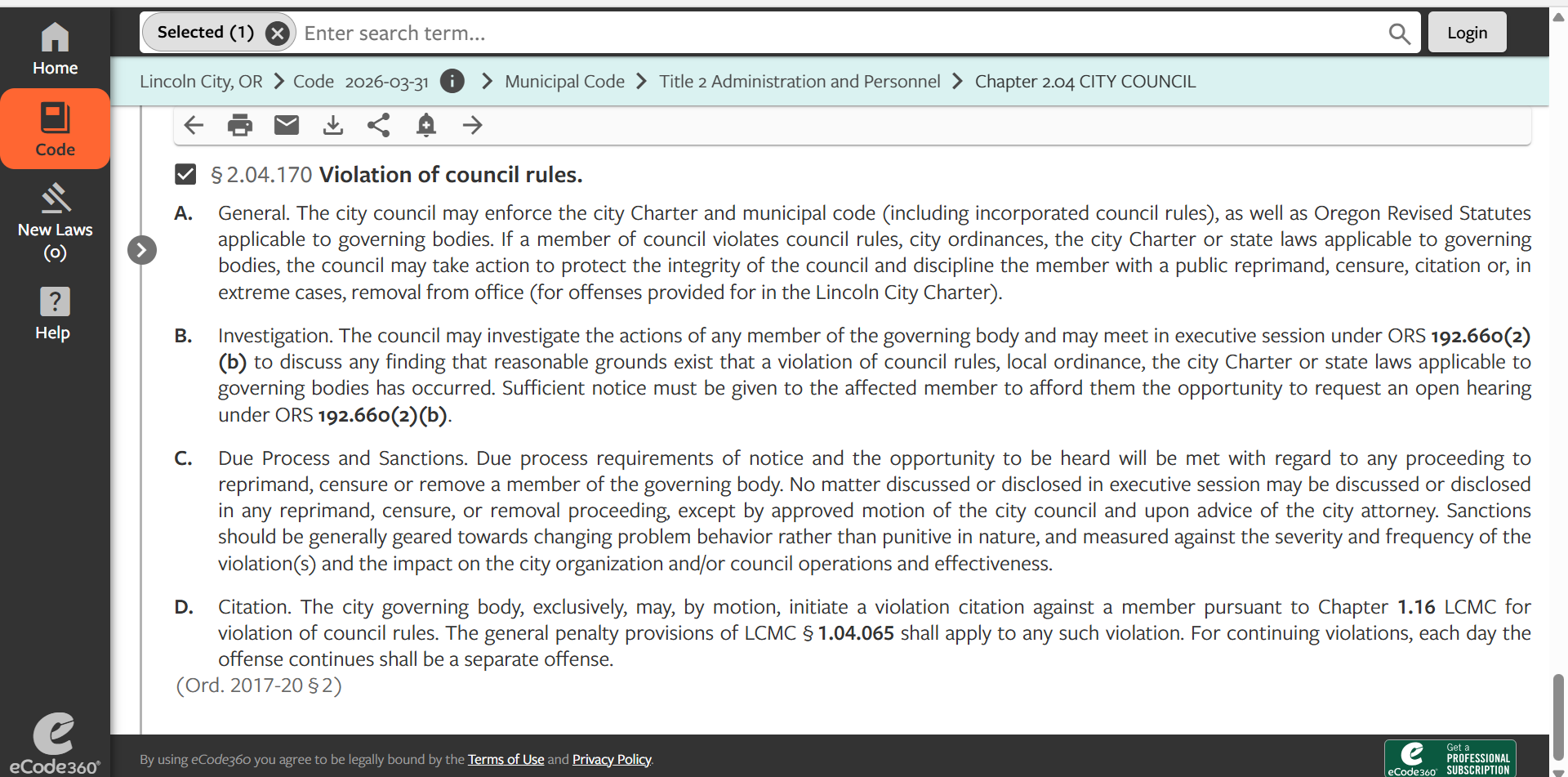
I appreciate the people who have asked me directly. I have been asking people to look at the actual laws, rules, and procedures that informed my vote, because this matters far beyond me or this election. The City of Lincoln City has adopted by ordinance how members of the governing body are to be disciplined. It is LCMC 2.04.170. This is one of the many laws I have sworn an oath to uphold, and most importantly, outlines due process requirements. Due process matters.
Our adopted procedures require investigation, clear allegations, and an opportunity to respond before disciplinary action is taken against an elected official. In my perspective, that never happened. From the beginning, I asked for accountability through an independent investigation of all parties and events involved going back to July 14, 2025. The council chose to move forward with a work session to “explore my actions” as a lower level first step. I was fully willing to be accountable for my actions, and I made that clear publicly.
The motion I voted “no” on was made at the next meeting following the work session and skipped over the required investigation, my rights to an executive session, and my right to respond to clear allegations. I would have voted the same way for any elected official or staff member whose due process rights were bypassed, whether I agreed with them or not. Because that is a principle. I do not use the word “principled” lightly.
I believe we must stand for fairness, consistency, and due process even when it is uncomfortable, politically inconvenient, or personally costly. That is what leadership requires. Especially right now, when our country is having serious conversations about government authority and constitutional rights, we should all understand how important due process really is and what it requires. It exists to protect everyone equally — especially in moments of fear, pressure, or pre-judgement. These principles are foundational to democracy itself.
Lastly, technically as a councilor I am required to vote on all matter unless I am excused by the Council or have a legal conflict of interest.
Did you feel the Recall Hall campaign was a big waste of taxpayer’s money?
I believe taxpayer dollars should be spent on the will of the people. I support the civil rights of all people in a content neutral manner.
In our representative government, the people have only a few tools to ensure their voice is heard; elections, legally protected public hearings, regulated public forums, referendums, initiative petitions, and recalls are some of those tools. I support the laws in place today to protect those rights, again, in a content neutral manner.
I want to acknowledge the leading nature of this question and add a bit of transparency that has not been directly requested of me. I am someone many people trust to help them navigate local government. I always do my best to make source information accessible to anyone asking, and encourage them to tell the deciding body what they think, when related to any upcoming decisions.
I had many people ask me directly how they should vote in the recall. My answer to all of them was this, "I will never tell you how to vote. What I will tell you is I have not seen any evidence that convinces me that solely recalling Commissioner Hall is going to solve all the issues at the county." To those who engaged deeper, I shared my gut feeling that if she were not on the board, that there could very well be unanticipated, unintended consequences.
Sadly, we can all see where we are today. This is undoubtedly a tragedy for our entire community.
Hi , I noticed there are no support groups in our country unless it has to do with addictions. I trained as a peer specialist in Corvallis back in 2008 and Lincoln county peers would have to travel to Corvallis for mh support. When I moved here in 2019 , I assumed this would have changed by then , I didn’t investigate it however. I was surprised there isn’t anything for me. Would you be open to help find grants to start some anxiety groups, depression groups , ptsd , etc? Our community is suffering with a wide range of mental health issues for a lot of us. People suffering with mh issues need to be met where they are at, instead they are expected to meet every one’s else where they want them to be. It doesn’t work that way, we desperately need support groups. Thank you. (anonymous)
Thank you for sharing this, and I agree with you. You’re right that our community is missing accessible, non-addiction-based support groups for things like anxiety, depression, and PTSD among many other types of support groups beneficial to individuals mental health. And more importantly, you named something deeper: people need to be met where they are, not asked to navigate systems that don’t reflect their reality.
I am absolutely supportive in this space, and also I believe we have many opportunities to be more creative with how we do it. We need spaces with licensed professionals offering more diverse support groups, and we also need more organic community connection as a baseline. Grants can be helpful, but they’re often temporary and restrictive. What I have been advocating for is building sustainable social infrastructure through partnerships with local businesses, shared spaces, and people who are already doing this work in informal ways.
To me, one piece of the puzzle that would serve many people in the community that are currently struggling is encouraging “third spaces”—places where people can gather, connect, and feel a sense of belonging without barriers. I’ve seen firsthand how powerful that can be. Before I was running businesses, I spent years bartending, and some of the most meaningful support I’ve ever provided to people happened in those everyday, human moments though simply listening, connecting, and making someone feel seen.
That kind of peer support is real. It’s valuable. And it already exists in our community, we just haven’t built a structure around it yet. I have a bartender working for me once that was also a licensed case manager and peer support specialist, and we once contemplated the value of a program for the hospitality industry workforce to gain these types of certifications from the state. This is an example of one idea that could create a system that serves people.
I would absolutely support exploring:
- Partnering with local spaces to host peer-led groups
- Connecting with trained peer support specialists in the area and brainstorming together
- Identifying what already exists and where the gaps truly are and setting goals
- And yes, pursuing grants and other funding to support and expand those efforts
More than anything, I want to help build something that lasts, something that strengthens connection, belonging, and resilience across our community. These are exactly the kinds of ideas that can turn into real solutions when we work on them together.
What specific steps will you take to support small businesses currently struggling in Lincoln County?
The first step is simple: listen to the people doing the work. We are a county full of small and micro businesses that are the lifeblood of our economy.
I will proactively connect with local business owners, established and emerging throughout the county, to understand what barriers they are actually facing. I want to hear directly where the process breaks down, what causes delays, and what challenges entrepreneurs encounter after deciding to invest here.
Having opened three businesses myself, I understand how complex the process can be. Business owners often must navigate zoning, comprehensive plan designations, building code, fire code, wastewater requirements, health licensing, insurance, workers’ compensation, lease negotiations, along with their own business plans and financing—often with little professional, much less centralized, guidance.
Examples of specific steps I would support:
- Improving access to clear startup guidance and educational resources
- Supporting business associations, mentorship and practical business education
- Creating better connections between local investors and local entrepreneurs
- Building opportunities for networking, pitch events, and collaborative support
- Enhancing partnerships and programs that ensure tourism spending draws visitors not just to our communities, but into our local business
If we want small businesses to thrive, we must treat their success as a county priority.
How will you streamline or improve permitting and regulatory processes?
We need to make the process easier to understand before people invest their time and money.
Too many business owners sign leases before realizing the space they chose may not legally accommodate their intended use without expensive upgrades or additional permits. Much of this confusion is preventable.
I would focus on two major improvements:
First: Create simple, user-friendly informational guides that clearly explain the permitting and occupancy process in plain language.
Second: Advocate for a dedicated county business liaison position whose job is to help business owners navigate county processes, identify bottlenecks, follow up on additional steps, and continuously improve the system.
That role should also track permitting timelines and performance metrics so we can measure where delays occur and whether improvements are working.
I would also work closely with partners like SBDC, Reinventing Rural, EDALC, chambers, contractors, real estate agents and independent business owners to ensure county systems align with real business needs.
What policies do you support that balance economic growth with preserving our character and natural resources?
Economic growth should build upon the strengths, and our local character and natural resources are among some of our greatest assets.
I support policies and programs that prioritize:
- Proactively address drinking water protection in our watersheds so we can continue to grow
- Balancing conservation with recreation so we can responsibly enjoy our natural environments
- Heritage preservation and Main Street programs that help revitalize and celebrate our historic districts
- Encourage the environmental tourism market, along with a culture of buying and supporting local
As a commissioner, I would advocate for convening organizations already doing the work around economic development, heritage preservation, environmental stewardship, community planning and emergency preparedness to create a cohesive strategy that positions future generations of Lincoln County to thrive.
How will you engage with business owners consistently throughout your term?
The same way I am engaging now: by staying present, accessible, and in conversation with the community. In many ways, this campaign is a prototype for how I intend to serve. I am building a model of ongoing public engagement that does not disappear after Election Day. My goal is to earn trust continuously through visibility, responsiveness, and real dialogue.
Success, for me, would mean any future campaign seasons would require no dramatic shift in my capacity or how I show up in the community.
Public service should not be seasonal.
What is your plan to attract new industries or investment while supporting existing businesses?
I strongly support attracting industries that strengthen the businesses already here.
Rather than importing disconnected industries that require education we don't offer here, and thus leave our existing workforce behind, we should strengthen the ecosystem around sectors where we already have demand, competitive advantage, and that create new attainable opportunities our workforce can grow into.
One example of a major opportunity I see is in building infrastructure around our existing food and hospitality economy. Tourism data consistently shows food and beverage is one of Lincoln County’s strongest sectors. We could build on that by supporting complementary industries such as:
- Agriculture and micro-farming
- Specialty food production
- Value-added processing and co-packing facilities
- Local supply chain development for restaurants and retailers
- Online markets with centralized shipping and inventory management
- Small-business collective bargaining
I also believe there is untapped potential in expanding heritage celebrations, professional conferences & festivals, indoor entertainment, shared mixed-use workspaces, and making it make sense for the businesses already doing business here to grow throughout the county.
When faced with competing interests, how do you evaluate and decide?
Every major policy decision requires balancing competing interests. There is no one-size-fits-all formula.
My approach is to:
- Gather complete and transparent information
- Ensure the public has meaningful opportunity to weigh in
- Look for solutions that maximize shared benefit whenever possible
- Evaluate tradeoffs honestly when no perfect solution exists
When weighing tradeoffs, we need to already know what we are not willing to compromise on for Lincoln County. I believe strongly in pursuing win-win solutions, and am always looking for that bonus “third win”.
What metrics will you use to measure whether your policies are helping the local economy?
I do not support adopting a new policy without first defining the desired outcome, and lastly ensuring the policy defines how success will be measured. The metric should match the policy.
For every policy I support, I will ask:
- What outcome are we trying to achieve?
- How will we know if it worked?
- What data will we track?
- When will we revisit the results?
I have consistently advocated for measurable goals in government because outcomes matter more than appearances. Good governance requires accountability, and accountability requires metrics. If we are not measuring outcomes, we are not governing—we are guessing.
What are your plans? (anonymous)
I never actually planned to enter politics, but I have found I love the work of representing my community in local government. What I’ve always been is a bridge-builder. Relationships matter deeply to me, and I believe a connected community is a resilient community. When we’re connected, we thrive in good times and we come through crises stronger. So my plan is simple: to be a connector, a listener, and a representative of the people.
I was raised with the belief that if you ever feel the urge to criticize how something is being done, you should be willing to step up and be a part of the solution. That’s exactly why I first ran for Lincoln City Council while serving on the Planning Commission. At the time, I felt that the statewide planning goal requiring governing bodies to "adequately" fund public engagement around land-use planning wasn’t being fully met; we had real budgetary limitations. Rather than criticize from the sidelines, I chose to take positive action and run for office. Three years later, Lincoln City is about to host its first community workshop collecting feedback on the new citywide engagement plan draft that aims to improve how the city takes in information, shares information with the public and address communications within the organization.
That work reflects the way I approach leadership: listen carefully to public concerns, identify where systems can improve, and help build solutions that continue working long after I step away from advocating for them. This is how we steward our public institutions as elected officials. It’s not easy work, and I don’t expect it to be. My experience in local government and my understanding of how these systems actually function will allow me to step in on day one and represent the people of Lincoln County thoughtfully and effectively.
I commit to being an informed representative - this means reading and understanding all the existing plans, how they are prioritized currently and what is and is not supported by the budget. I am passionate about community visioning and strategic planning, along with regular evaluations of what is working and what needs adjustment. I am a systems thinker that believes in understanding the interdependence of all systems prior to suggesting changes. My decisions always weigh public confidence, responsible stewardship and community resilience.
Where will your campaign funding come from?
Some campaigns launch with just a "Donate" button. I personally have a hard time asking people for money I do not truly need. I also recognize the economic realities many families in our community are facing. I am someone who ran two restaurants through the pandemic, and then had a car hit the front of our business and shut us down in 2024, and I was able to navigate those challenging financial situations without asking for assistance from the community.
At this stage, I’m focusing on running a campaign that grows organically through conversations and community support rather than large fundraising efforts.
Local campaigns do have some basic cost (things like filing fees, printing, and outreach materials) but I’m intentionally keeping spending minimal and focusing first on connecting with voters across Lincoln County.
For those insistent on making a donation, a check (no cash) can be made out to:
“Friends of Marci Baker”
and mailed to
PO Box 656
Lincoln City, OR
97367
Please include the required donation information:
Name, address, employer, occupation
...or your contact information.
Oregon offers a ($50 per individual) Political Tax Credit, which allows many residents to receive a credit on their state taxes for qualifying political contributions. As required by Oregon law, all contributions and expenditures will be publicly reported through the state’s ORESTAR system so per state requirements anyone can see exactly where campaign support comes from.
For now, the most valuable support people can offer is helping spread the word, asking your questions and participating in the conversation.
As a candidate for county commissioner what is your thoughts on aligning yourself with a party be it republican or democrat or independent for a position that is supposed to be non-partisan? Would you take an endorsement from a PAC? Would you take an endorsement from a super fan that's aligned with one of the three political parties?
I understand the value candidates gain by being willing to place an "R" or a "D" next to their name, along with what they sacrifice when they swear loyalty to a Party over the People. Government works best when decisions are informed by local needs, and will never do anything to compromise my ability to freely represent the community I serve.
My campaign is not aligned with a political party, and I will not be accepting funding from Political Action Committees (PACs) affiliated with major political parties. I am transparently non-affiliated and could talk for hours about the ways in which the "Political Industrial Complex" does not authentically serve representative government. I do not prefer one party to the other and see them as equal parts of the plurality system that most Americans do not feel serves their interests. I also do not say this to discount anyone who does feel a major party represents their interests, I simply believe partisanship is not relevant to the services provided by local governments. This is why I love non-partisan local government and feel well suited for the work we do.
County Commissioner is a nonpartisan office, and that term has a specific meaning in Oregon law. Nonpartisan positions do not run through party primaries where candidates seek a Republican or Democratic nomination. Instead, candidates appear on the ballot without party designation and are elected by the entire community. That structure reflects the nature of local government. County government focuses on services that affect everyone. Those responsibilities require us to work across political differences and focus on practical outcomes for the whole community.
Being in a nonpartisan office does not mean elected officials are apolitical or that we lose our First Amendment rights as individuals. People naturally have viewpoints and affiliations. But when we serve in office, our responsibility is to represent the entire community and operate within the rules and responsibilities of that governing body. My personal approach reflects that purpose.
At the same time, I recognize that people of many different political perspectives care deeply about this community. Because I engage openly with people across the political spectrum, I’ve found that supporters of my approach to local governance come from the full spectrum of political backgrounds, including many with strong associations with every variety of political party in Oregon. This creates an interesting challenge when it comes to endorsements. In today’s political climate, sometimes an endorsement from one highly political individual can turn off voters who associate that person with a particular ideology. I understand that dynamic.
What matters to me is not which political tribe someone belongs to, but whether we can work together to solve local problems. If people from different viewpoints support my work, I see that less as a political signal and more as evidence that my approach resonates beyond a single clique or faction.
I approach local leadership as a bridge rather than a banner. My goal is to bring people into the conversation who might not normally talk to each other and focus on the issues we all share as a community.
My favorite definition of community defines it as “a place and its inhabitants.” That includes the people who live and visit here, the children who cannot vote yet, the infrastructure we’ve created, our natural spaces and wildlife that make this place what it is. Ultimately, my responsibility isn’t to a party or even just to the voters who elect me. I am responsible to the community as a whole. Practical solutions are built on common ground. That’s how I approach public service.
What would you plan to do about the housing shortage throughout the county, while allowing a key local industry, like STR's to still thrive?
Housing and short-term rentals (STRs) are often framed as if they’re competing priorities, but on the Oregon coast they’re really part of the same system. Tourism is a key part of our local economy, and short-term rentals play an important role in that. At the same time, the housing shortage is very real, and we need more homes for the people who live and work here.
Lincoln City has the highest concentration of short-term rentals in the county. I come to this issue with a long history. I started cleaning vacation rentals in high school and later worked as assistant manager for one of the largest vacation rental companies on the coast. In fact, vacation rental dwellings were the first issue that drew me into local government in my early 20s.
I have not seen any statistics that reliably show increasing regulations around short-term rentals results in an increase in available year-round housing. In Lincoln City, when year-round licenses were capped, and then later accessory-use licenses were eliminated, many homes shifted into furnished monthly rentals that easily rent for around three thousand dollars a month. Those technically count as long-term housing, and are a needed housing type, but they’re still far out of reach for many workers.
I do not believe the housing crisis will be solved by simply pressuring private property owners through regulation. If we want property owners to be part of the solution, government tends to be far more effective when it uses thoughtful incentives that align private investment with community needs.
So the larger issue is really about land use, enforceable regulations and neighborhood alignment.
Short-term rentals function as lodging units, and some are year-round businesses. Many are located in residential areas that were never designed for that level of activity. I would advocate for broad community visioning so we can be more intentional about where new vacation rentals are located. For example, Lincoln City’s new 2043 Comprehensive Plan set a new strategy of decreasing short-term rentals in residential neighborhoods while increasing the number in commercial zones. I believe mixed-use zones are another place where they can work well. Those areas already blend residential, commercial, and visitor activity, and they can support both long-term and short-term housing while still creating vibrant community spaces.
Next, enforcement has to be realistic. If we require a local contact, that person should truly be local. Communities become frustrated when the number they’re given connects them to someone halfway around the world. They wonder what the impacts would be if there were an emergency. I’ve also personally observed that smaller, locally based management companies often maintain better relationships with neighborhoods than large national management firms. Meaningful enforcement requires metrics to be evaluated on a regular basis. Outcomes matter.
Infrastructure is another important piece of the conversation. Traditional lodging developments pay system development charges and commercial utility rates, but most short-term rentals, particularly in residential zoned neighborhoods, were originally built as residential homes and never paid those charges, and are billed residential utility rates. When we have hundreds of lodging units operating in that way, it’s worth asking whether our fee structures reflect the actual demand being placed on water systems, sewer systems, and other infrastructure.
One idea I have advocated exploring in Lincoln City relates to including water conservation as a value that informs our regulations. Many municipalities in Oregon are currently looking at water and sewer revenue challenges, and one approach could be designing rate structures that reward conservation practices. For example, if vacation rentals were charged commercial water rates with a lower base allowance and significantly higher rates once usage exceeds certain levels, owners would have a strong incentive to conserve. That might mean installing efficient fixtures, replacing older appliances, or even rethinking amenities that consume large amounts of water. Guests might see signs encouraging shorter showers or other conservation practices. Those changes could reduce strain on our water systems while still giving property owners control over how they manage their costs.
But I want to be clear about something. I don’t approach issues like this believing I have the single right answer. What I bring to the table are ideas and experience, and then I work collaboratively with other elected officials, staff, industry partners, and community members to develop solutions that make sense for the whole county.
Short-term rentals, housing supply, tourism, and infrastructure are all interconnected. We didn’t arrive at these challenges overnight, and we won’t solve them overnight. What we can do is approach them thoughtfully, increase the overall supply of housing in all its forms, and create policies that balance economic vitality, property rights, and livable communities.
What (if there is something that can be done) would you do to help get more medical therapy into the north end of the county? Seems there is lots in Newport, but not up north.
Access to medical therapy throughout the county is a real concern. We have a large community of people who move here to retire, and eventually move away due to lack of access to needed care. We also have a high percentage of people under 55 living with a disability, many requiring specialized care. Everyone in Lincoln County deserves access to care, regardless of where they live. While the County doesn’t directly operate most healthcare services, it does play an important role in coordination, access, and removing barriers. Here are a few areas I would focus on:
First, understand the gap clearly. Where are the shortages—physical therapy, mental health, occupational therapy, addiction services? Who is trying to provide services but can’t expand, and why?
Second, supporting provider expansion. That can look like working with existing providers to identify barriers—whether it’s space, workforce, transportation, or funding—and helping connect them to resources, partnerships, or potential sites on the north end.
Third, bringing services closer to people. If we can’t immediately bring full clinics north, we can support mobile services, rotating clinic days, or shared-use spaces in existing community buildings.
Fourth, coordination and advocacy. Of course, no one commissioner has the power to do these things alone, but I would actively work with the HHS team at the county to learn what I don’t know, and connect with potential partners in our community and beyond. The County can play a stronger role in bringing together healthcare providers, nonprofits, and regional partners to align efforts and advocate for funding and workforce placement in underserved areas like ours.
And finally, transportation matters. Even the best services don’t help if people can’t get to them. We do have some great programs, like Dial-a-Ride, but there are gaps to fill to equally offer services to all county residents.
To me, this isn’t about one big fix. It will require being intentional, collaborative, and persistent in closing the gap over time.
Do you strongly oppose operating an ICE facility in Lincoln County? (anonymous)
This question asks about my personal position, so I want to answer it clearly and directly:
Yes, I am personally strongly opposed to an ICE facility in Lincoln County.
I am happy to respectfully discuss the merits of our individual opinions with anyone one on one, on any topic.
Also, my personal opinions are not what I vote based on as your representative.
I want to share a relevant example of how I approach decisions like this as your representative. You may or may not know this issue was brought before the Lincoln City Council in January. The issue was brought forward during Public Comment, so it had not been noticed on the agenda. I first became aware of it through written public comment just hours before the meeting.
My vote in that meeting was not a “no” on the issue, but rather it was a “no” on the narrow scope of the specific motion that was on the table. I did not feel the initial motion fully represented the range of concerns shared by community members that night. I was a “yes” vote for making sure what we passed actually reflected our community, rather than adopting language from another city without doing that work locally.
Following that meeting, I went to work. I developed a set of listening questions and spent six days engaging directly with community members to better understand their perspectives. I then drafted a broad resolution based on what I heard and shared it publicly so people could provide feedback before any decision was made. I knew it could be weeks before we would get anything back from legal for the public to review, so I spent close to 100 hours on this work over two weeks. In the end, that dedication contributed to FIVE resolutions being brought forward all noticed on the same agenda, and ultimately the Council unanimously adopted the version that had the strongest community support.
I believe meaningful public engagement is essential to good governance.
I listen first, do the work, and bring forward solutions grounded in the people I serve.
Lastly, I am always eager to provide clarity around misunderstandings and misinformation which there unfortunately has been in our community about me regarding this topic since it came before the council. I hate that I even feel the need to address this, and give any attention to it, but I have heard and seen enough. I cannot allow these blatant lies to go uncorrected, though I am not willing to engage in partisan narratives or defend against mischaracterizations.
Here are the facts tied to what I am aware is being said:
- I never “tried to bring ICE” to our community.
- I never “refused to sign” any resolution, I do not even have that role as a City Councilor.
- I have been quite shocked by the suggestion that I am affiliated with a “maga” movement to take over Lincoln County. Anyone who knows me knows how silly this is to even suggest.
- I have never attended a Turning Point USA conference in Coos Bay with David Elton.
These rumors and lies cause harm and sew distrust in our community, which I take seriously.
I would like to respectfully ask whoever is making these things up and spreading them around to please stop manufacturing fear tied to my name.
I encourage anyone to reach out to me directly, express whatever concerns you might have. My focus continues to be showing up, staying grounded, and doing the work so that when decisions are made, they are thoughtful, transparent, and truly representative of this community.
Thank you to the person who asked this question anonymously and requested a public answer. I appreciate the opportunity to address all of this.
If you’d like to dive deeper into seeing how I speak up as your representative, please feel free to review the process that happened in Lincoln City mentioned above. You can click on the agenda section, and the video will jump to that part of the meeting. I took the time to pull out the time stamps since many of the meetings are 3-4 hours.
City Council Regular Meeting - January 12, 2026
13:30 - 42:50 Public Comment
2:04:00 Council discussion begins on topic:
2:10:30 - 2:21:20 Motion to bring back a resolution based on Toledo's opposing detention facility
2:23:48 - 2:33:00 Additional Public Comment
2:35:40 - 2:42:40 My Councilor Comments
City Council Regular Meeting - January 26, 2026
6:00 - 1:09:00 Public Comment
3:46:37 - 3:55:30 Additional Public Comment
3:59:00 My Comments regarding my efforts to reflect public comment into draft resolution
4:11:20 - 4:12:35 Motion to Send Additional 4 Resolutions for legal review
City Council Regular Meeting - February 23, 2026
05:18 - 36:48 Public Comment
1:14:40 -1:42:34 Resolution 2026-06 ICE Facility
Are you in favor of sanctuary cities? (anonymous)
This question often comes with a wide range of meanings, so I want to start by clarifying the context. I seek to understand my constituents’ views in order to represent them, not to exercise my personal beliefs. I can confidently say I am personally a supporter of "home rule" and the 10th amendment. I am always happy to discuss my personal views one-on-one.
As an elected official, part of my job is to ensure that our policies are lawful, clearly understood, and reflect the values of the people I serve. That includes prioritizing public safety, maintaining trust between local government and the community, and being transparent about how decisions are made. Currently in Oregon, state law already limits the use of local resources for federal immigration enforcement. That framework exists regardless of whether a community uses the term “sanctuary.” If this issue were to come before the County, I would approach it the same way I approach all decisions: by engaging with the community, understanding a range of perspectives, and doing the work to ensure that any action taken is thoughtful, transparent, and grounded in Lincoln County values.
Is it true that David Elton is a big supporter and contributor to your campaign? (anonymous)
I want to be very clear, I am not affiliated with or directed by any individual.
My campaign is grounded in direct connection with this community, and my positions are my own.
My commitment is to represent this community with integrity.
I understand why people are asking these questions - there’s a lot of noise right now.
If you have heard David Elton, or anyone other than my immediate family has contributed money to my campaign, that is false.
If I were taking donations from anyone, I would have a button on this site. I have no control over who says they support me.
I do not engage with divisive or identity politics and am focused on local issues.
Misty Lambrecht with Webfoot Marketing and Design has made an in-kind donation of initially setting up this website for me to self-manage.
My husband and I contributed $525, and my dad mailed me a check for $500.
I have spent just under $400 on printed materials from Quality Printing Service in Lincoln City.
Questionable Questions...?
I am still answering all questions, but will not allow the tone and attempts at false implications or narratives contained in these anonymous, repeated questions to dictate this campaign.
I reject these tactics being use in our community and find it disrespectful to attempt to hijack this system I designed to serve you. I engage equally with all people.
All information related to the anonymous complaints mentioned can be found here.
How can you both “never violate the rules of decorum” and also engage in all these fights on social media? You remind me of a lot of Trump.
Being the subject of ongoing harassment and refusing to silently be abused is not engaging in a fight. Decorum applies to meetings. You have no source for your quote because I have never claimed this. That also does not imply I have violated any rules. This is another clear example of how disingenuous questions are used to write a false narrative. Your words and actions are a reflection on you, not me. I set up a system here and am committed to responding to every question, and I am also responding to anywhere on social media my name is brought into the conversation. I can't control who shows up trying to pick a fight, but I do not engage on that level.
You did not claim any sort of misconduct by staff, directed to you, the staff made claims against you. That takes precedence. You are not the victim here. Your refusal to acknowledge this and your attempt to flip the script is noted. What are you going to do differently, if county staff have complaints about your behavior?
Who are you to tell me what my experience was? How would you know if I did file complaints or not?
As far as the next time this occurs, I'll deal with that when I get there.
Again, I will state, no one on council ever actually saw any complaint, and we were instructed that nothing about my actual actions could be discussed at all; only emails. Have you read those emails? Have you read the applicable statutes? Did you listen to all my councilor comments in our meetings between 8/25-10/27? I already took all the time to make the whole timeline with timestamps available due to outright lies being spread about this situation. I will not dedicate more to this back-and-forth.
People all have rights to due process in this country and no one should be labeled and harassed and punished in an ongoing public manner like this simply because a complaint is filed. Anyone can file a complaint. This has only come up to be twisted into slander during this election because you have nothing legitimate or factual you can say against me, because I am a dedicated public servant that loves this community and has done everything I have because of pure passion, as a volunteer.
I am now asking you to stop disrespecting my platform here. Four rude and leaning questions in just over 24 hours is excessive. I respect the existing EEO and anti-workplace harassment policies and will not be commenting on this further, as I have provided all the factual information that I am able to speak to, and I am not your punching bag.
You have stated many times, on social media and elsewhere, that you aren’t afraid to disagree or to challenge policy and procedure. If you were truly concerned that the correct process was not followed, with respect to investigating your conduct and potential dismissal and discipline, then city staff did not have the benefit of it either. How can anyone be assured you will support the rights of county staff when you will not insist on adequately the addressing the issues that were brought by Lincoln City staff?
Your questions will now be categorized as questionable. I do not appreciate the twisting of my words and implications you are attempting to insinuate.
I will always uphold my oath of ensuring legal processes are followed. I am not challenging any legal process.
Why don't you ask other members of the Council why they could not be bothered to read the applicable laws? Have you bothered to read them?
There is a legal process for disciplining elected officials - this was not followed.
There are state statutes for addressing anonymous complaints - these were not followed.
I have never seen a complaint to act on.
I do not think anyone ever will.
What about how I was treated?
Where was my complaint channel?
Do you have no concern for that?
Would you make a motion to reopen the question of your conduct with city staff, to allow an independent investigation, in order to address their concerns? (anonymous)
I expressed multiple times I felt this was the appropriate direction to take. The Council went a different direction. We have rules that state once the Council takes actions we all support the direction of the Council. Based on the information provided at the 10/20/25 work session, it was stated that no discussion of any of my actual actions with staff could be discussed, and all that could be discussed was my emails.
So no, at this time I do not feel it would be appropriate for me to make such a motion.
If you weren’t given a proper investigation into your conduct, then what are you doing to ensure the staffers that brought concerns to light are having their rights protected and their concerns addressed appropriately?
Here is the uncomfortable truth: as one member of a governing body, I cannot personally ensure outcomes. The Board of Commissioners has authority as a body, not a individuals. I can make motions, provide information, ask difficult questions, advocate publicly, and push for accountability. This election is so important because governing bodies act collectively, which means it takes two. In my role on city council, with seven members, it takes four.
I will note, the one exception is if a commissioner is Chair of the board during a vacancy in the office of County Administrator. My understanding is, last year (11/5/25) when that order was adopted, the authority was almost immediately delegated to staff via email. I would not delegate my responsibility via email as I believe these significant changes belong in a public meeting because the public deserves to know how decisions are reached. We have not had a true Chair elected on the Commission this year, so that authority lies somewhere with staff. I believe this is a key factor in this present governance failure moment.
What I can ensure is this: I will continue to advocate for lawful process, transparency, and fair treatment for everyone involved. That includes the rights of staff to safely raise concerns, and the right of any accused individual to proper process and investigation. Those principles are not in conflict. In fact, they depend on one another.
I will not stop advocating for systems that protect people over politics, process over rumor, and truth over convenience. I am someone who will take great personal risk to protect my team, everyone has a right to due process and equal treatment.
Step one is the board addressing collapsed complaint channels, ensuring at a minimum there is an avenue for the Board to receive complaints directly, and also reviewing existing complaints and how they are being addressed. I would always have an open door policy, where anyone would be welcome to communicate with me in confidence, with respect to confidentiality and protected information.
Have any members of the Hilltop Patriots come to your cafe to meet with you to discuss public comment in Lincoln City City Council meetings? (anonymous)
I am sure, over the years, I have spoken with hundreds of people in my business regarding Lincoln City Council meetings. I do not classify people based on what local groups they may or may not participate in. I have met with members of the Lincoln County Democrats (specifically about public comment and public engagement) and Lincoln City Indivisible in my businesses as well.
Kindred, by Zest is proudly listed on the Out in LC directory - and yet I hear are slandered and described a being "maga" via word of mouth in the community. It is heartbreaking to me that people would try and keep members of our community from having access to a safe space and cause fear that is knowingly false.
Just a clarification, the Hilltop Patriots do not have membership or "members". Not sure why there is so much focus on this local group that isn't even partisan.
You quibble with any language you can to deflect criticism, and argue about process rather than concede that you were brought before council for your conduct. That’s a Casey Miller strategy. Why should anyone believe you won’t do the same if you are elected? (anonymous)
Anyone can submit an anonymous complaint. That does not mean an elected official is automatically "brought before council". The governing body is legally required to make a motion to hear the complaints in executive session, and all people have a right to due process. This never happened. Things can become very confusing when our adopted procedures and laws are ignored. Elected officials are NOT the same as public employees.
I clearly and repeatedly advocated for an unbiased investigation of all parties actions going back to July 14th, 2025, and have never deflected criticism or accountability. I openly asked for any explanation as to what actions of mine could have been done differently and never received a single explanation to this day.
Watch the time stamps from the 9/29 meeting I shared on the governance page.
I used the Marci Baker strategy of documenting everything, putting everything on the public record, showing my work, and upholding my oath of office. I had never spoken to Casey Miller until this year, but did have many people tell me what happened to him is what was being done to me, that I was "being Casey Millered". There are some parallels, but not the ones this question is attempting to draw out.
If elected to this role people can expect I will uphold my oath, regardless of personal scrutiny or cost, same as I have in the elected role I serve in now.
I’ve seen the October 20th video. Clearly the council was reviewing something. You simply refuse to admit they were complaints. Why did some of the council vote for your sanction, as a result of what they saw? (anonymous)
To be clear:
- The October 20, 2025 work session is only available as an audio recording.
- I have never claimed there were not anonymous complaints made.
- None of the council voted to “sanction” me, the motion was to issue a “reprimand”; these words mean different things and they matter.
- I do not know why three members of council voted to skip my right to an investigation or to have specific allegations heard in executive session, but I am glad three of us did not vote to violate LCMC 2.04.170 "Violation of Council Rules". It is my understanding, that could have potentially created expose for the City of Lincoln City. We all have taken an oath to uphold the Lincoln City Municipal Code.
I suggest you watch the September 29th meeting starting at 1:14:45 and view this discussion. Note when Council President Hoagland outlines how he sees this being potentially three meetings. That is not what occurred. Full timeline with detailed timestamps made available by me here.
What were the complaints brought to city council about your conduct? (anonymous)
No one on the council ever saw a complaint. I recommend listening to the October 20th work session if you want to understand as much as anyone was able to.
Why are you only posting some of the questions? Are you afraid to acknowledge what your constituents want to know about your conduct? (anonymous)
I have posted every question submitted to me so far. I have to be on my laptop and update the website to provide answers. I do this as I am able and have been able to address every question with 72 hours. I immediately call anyone who submits a phone number, whether they request a public or private answer, to let them know I have received their question and have the opportunity to talk about it if they would like.
I’m not afraid to answer questions about my conduct.
In fact, I’ve gone further than anyone else involved by organizing records, timestamps, meeting links, and source materials so the public can review the actual record themselves rather than relying on rumors, summaries, or secondhand interpretations.
It’s also worth noting that none of the discussions Council had regarding complaints made, between 8/25/25-10/20/25, were noticed as agenda topics to the public at the time they occurred. One reason I created the governance page and public record resources was specifically to make this information more accessible and easier for residents to independently review.
I believe transparency means helping people access primary sources and come to their own conclusions.
You said you generally support common interests above special Interests- that sounds like the dog whistle for discrimination against some marginalized groups, rather than a someone who describes herself as trying to engage. What is your relationship with the hilltop patriots? (anonymous)
I reject the premise and implication of this statement made in this anonymous submission.
When I talk about common interests over special interests, I mean that I firmly believe elected officials should always prioritize the public interest over political action committees (PACs), donor groups, private entities, and especial their own personal interests. I’ve been very consistent about that, including my decision not to accept PAC funding or even run a heavily financed campaign - whether grassroots or personally funded.
I believe every resident deserves equal representation and equal access to their elected officials, regardless of background, ideology, identity, tax bracket, or well represented special interest affiliation. All voices deserve to be heard and weighed equally, whether we might personally agree or not. I suggest great representatives are aware that every person carries different biases, and keeps a check on their own.
As for the Hilltop Patriots, my relationship with them is the same as my relationship with all community groups throughout our community: if invited, I will to show up, listen, answer questions, and always engage respectfully. I will never avoid a whole group or even one individual because of how they are perceived by others. Considering they have been singled out by this anonymous question, I want to be sure to provide a link to their website for those who may not be familiar: HilltopPatriots.org
Some members, like many people involved in local community groups, are people I’ve known for many years simply through living in this community for decades, some since I was child. I will say, based on my experience getting to know many member personally in the last couple years, and attending a few of their meetings, I believe they are a very misunderstood and mischaracterized as a group. It would be impossible for me to agree with "their views" because, like in every group, they don't all agree with each other!
I believe representation means engaging equally with all people and community groups. This may feel unfamiliar because, as a non-affiliated elected official who intends to stay that way, I do not experience the social pressure concern myself with all the possible uninformed interpretations anyone might make based on their perceptions.
I know my intentions, and I know I am always openly available to speak with anyone about any concerns.
My approach is consistent across the board.
I treat everyone as individuals and hug a lot of people.
I never avoid sitting next to anyone.
I don't care if someone takes photos.
You were brought before Council because of complaints about your conduct, by city staff. Correct? Yes or no, please. (anonymous)
Unfortunately, based on the grammatical structure to this statement contained in this anonymous question, I am not able to provide a simple “yes” or “no” without the opportunity to seek clarification.
I see two possible interpretations of the initial statement I am to confirm or deny:
You were brought before Council because of complaints by city staff about your conduct.
You were brought before Council by city staff because of complaints about your conduct.
If the intention is the first, I cannot speak to that as, to my knowledge, anyone can submit an anonymous complaint, and I would never make any attempt to identify an anonymous complainant. I can clarify the anonymous complaints were regarding “my interactions with staff”.
To the second intended possible meaning, YES and is the most relevant fact I can point to regarding the confusion surrounding this matter.
The authority to discipline an Elected Official rests with the Governing Body through a lawfully defined process.
Based on my understanding of the city’s municipal code, City staff do not independently have the authority to discipline or formally bring an elected official before Council based on anonymous complaints without direction to do so from the governing body in a public meeting.
Reference: Lincoln City Municipal Code: LCMC 2.04.170A-D “Violation of Council Rules”
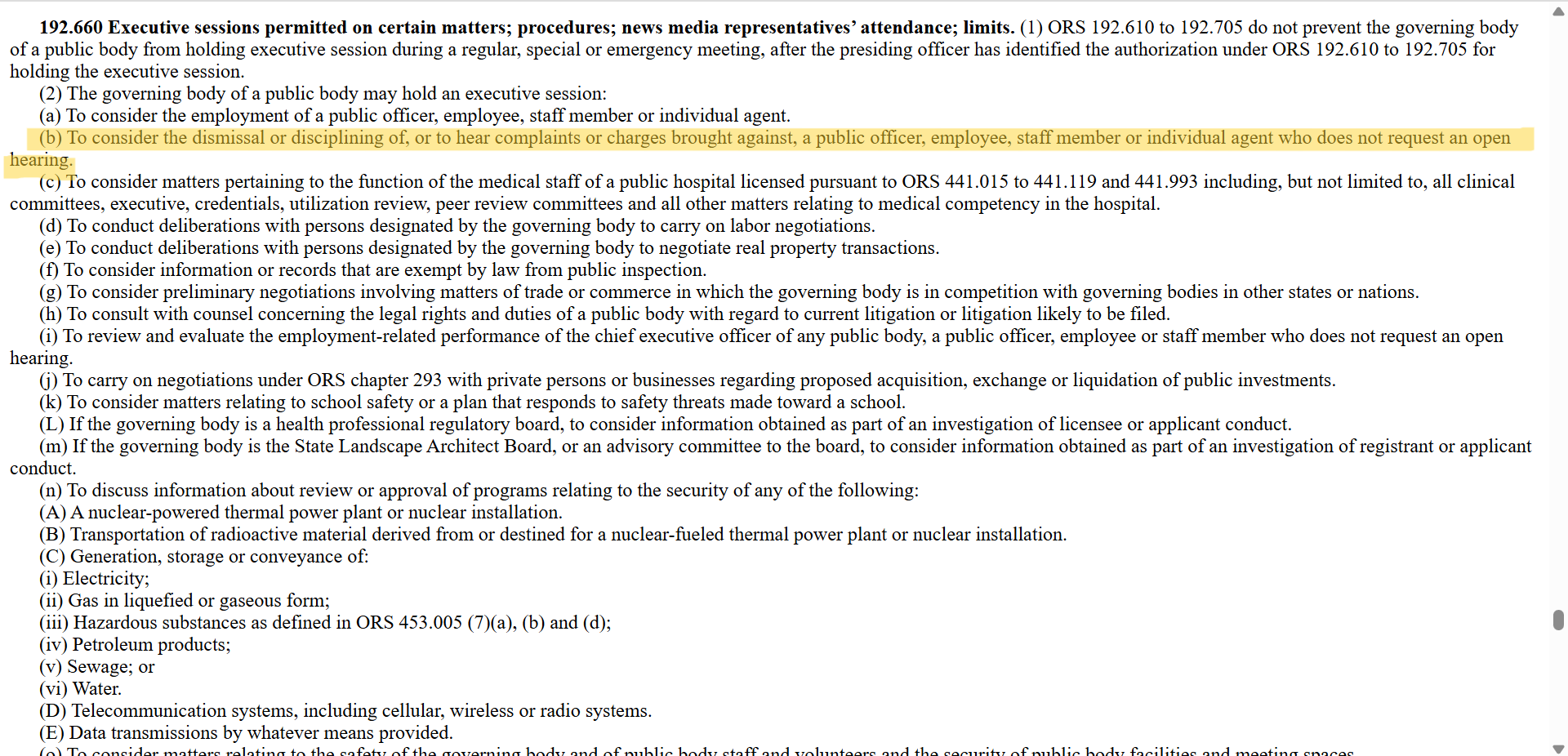
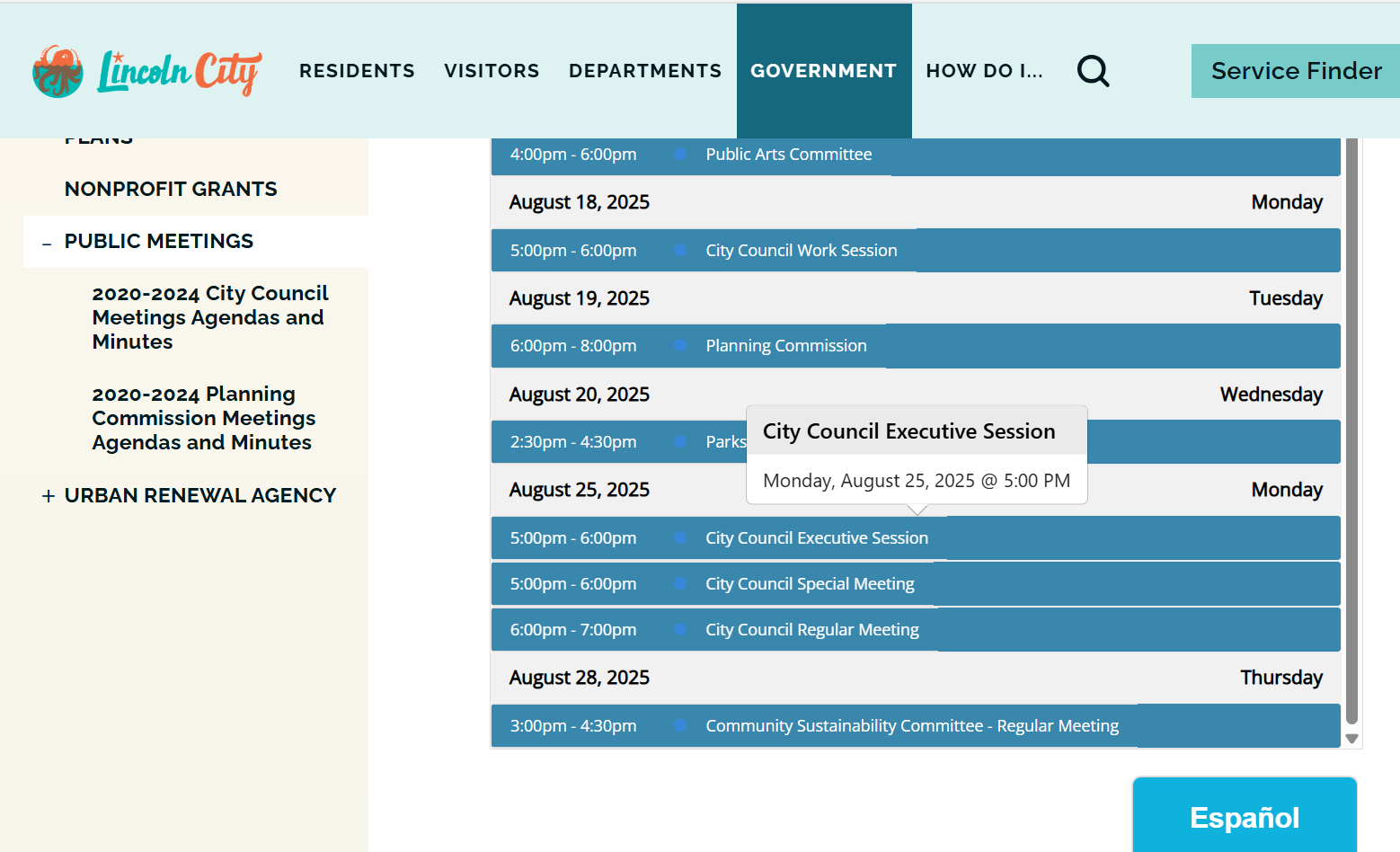
So, yes - the August 25th meeting, originally noticed as an “executive session” regarding complaints about my “interactions with staff”, was scheduled by city staff through the regular administrative meeting and agenda setting procedures. The ONLY reason that “executive session” was canceled and a “special meeting” scheduled, public, recorded, and is available for anyone to view today and into the future, is because I exercised my right as the subject of the hearing to have it heard in open session, per ORS 192.660(2)(b). It is of note that decisions can not be made in an executive session, but could have been made in a noticed public meeting "special meeting." Learn more about how executive session laws in Oregon exist within public meetings law for the purpose of balancing transparency and confidentiality.
My concern, which I stated repeatedly on the record, is that I believed aspects of that process conflicted with my understanding of our municipal code and the lawful role distinctions between staff and elected officials.
See the following question for more details as well.